The Future of Software: Beyond the Code
For the past three years, the tech community has anticipated a tidal change in the industry. A change that would affect every role and every aspect of every job. It was first approached with skepti...
For the past three years, the tech community has anticipated a tidal change in the industry. A change that would affect every role and every aspect of every job. It was first approached with skepticism by senior technology professionals, including myself. Many of us tried the early LLMs on small software projects and quickly disregarded the technology as unreliable, unable to work within the complex constraints of real-world codebases, or simply “not smart enough.”
We were drastically underestimating the full potential of Large Language Models and the determination of frontier AI labs like Anthropic and OpenAI to solve software engineering as their first use case.
After several step-function improvements in pre-training and reinforcement learning, the tech world experienced a seismic shift with the sudden release of AI Models like Opus 4.5, GPT 5.2, and Gemini 3.0. These models, now able to create fully working software platforms in days that would typically take the best of us weeks or even months, are showing us skeptics that the skills we have worked so hard to build over many years are soon to be fully commoditized. Even the remaining resistance of senior engineers within large corporations who hold on to the argument that these models will “never handle the complexity of large Enterprise systems” is quickly fading. They are realizing that with the right approach to documentation, training, and tooling, AI agents will soon operate autonomously within the enterprise. They will pull up the next ticket, research the right approach across hundreds of systems, build and test the code, and release and maintain production software.
This leaves us humans little else to do than review design proposals, audit test results, and oversee code delivery.
The Reality Today: Inside Hypertrail
In many ways, we are already working this way at Hypertrail. Our agents pick up the next item in our backlog (we use a vibe-coded tool for ticket tracking that is purpose-built to be used by both agents and people). Agents deliver design docs as Markdown files in Git Pull Requests. We review and comment. Agents pull the comments and make changes. When we approve the design, the agent writes the code and tests, runs the tests, and submits a pull request with the final changes.
We do a final code review. The agent then does the staging deployment and monitors the pipeline, fixes issues if the staging pipeline fails, and keeps us up to date via Slack. We then load into prod and have the agent (with a read-only role) monitor the production pipeline run. We have agents with different dev machines and different AWS account access for different purposes. One agent maintains our public website, two agents work on our main platform, and one agent builds demos for upcoming pre-sales opportunities. This is all real and all working for us today.
The only reason we don’t have yet 100 agents building our 10-year roadmap in a year is that we don’t have enough people to review the work yet, and agents are not quite reliable enough to run 100% autonomously.
The Landscape: Who Survives?
To fully apprehend the magnitude of the change we are about to experience, let’s review today’s tech landscape. We will look at how the three main types of players (Big Tech, Vertical SaaS, and Startups) will fare in a world where building software is as common as paying for electricity.
1. Big Tech (The Giants)
In the pre-AI world, The Tech Giants like Amazon, Apple, and Google were invincible. With unlimited resources and deep technical expertise, they were unlikely to be challenged. However, in a world where humans primarily review and audit, bureaucracy becomes a threat rather than a safeguard. Companies with centralized, top-down operational planning (like Amazon’s bi-annual OP1/OP2 mechanism) will soon discover that the best ideas do not make it to the top and back down for execution fast enough. Furthermore, the overhead of security, risk management, and hierarchical control put in place following decades of big public failures can no longer be compensated by spending billions of dollars to build high-performing tech teams.
A specific vulnerability for Big Tech is documentation. Much of their legacy code was built by “2-pizza teams” of rock-star engineers who valued individual brilliance over shared ownership. I have seen many instances of production software failing and a team left with no knowledge of the software architecture because “the guys who built it left or got laid off.” AI needs context to execute. For an AI agent to create designs and generate code, it needs to understand the platform it operates in. Big Tech will need to spend massive resources “reverse documenting” their code using Human + Agent teams.
Verdict: They will remain on top for a long time, but only because of their physical moats: cloud datacenter footprints, supply chains, and chip manufacturing.
2. Vertical SaaS
There has been plenty of talk about a “SaaS-pocalypse” sending stocks to the ground. While the idea that AI will instantly kill SaaS is an exaggeration, the pressure is real. Historically, an Enterprise “Build vs. Buy” analysis compared the value of the software to staffing a long-term team of engineers to build and maintain it for a decade.
With engineers being paid $200k–$500k each, the SaaS providers had ample margin to operate. I have personally witnessed enterprise procurement approving $3–5 Million dollar contracts on a “Customer Data Platform” while accepting a 12–18 month implementation timeline, simply because building it internally would cost more. Today, that math is broken. A $1M SaaS license is essentially the cost of a 2–3 person team. Except now, a small and nimble team of engineers can easily build and maintain a targeted version of a CDP or CRM in months using AI.
Mission-critical systems (Airline PSS, Core Banking) will likely remain purchased due to risk and SLAs. However, for any other system, if SaaS providers continue to hold customer data hostage, delay key features, and charge millions for shelf-ware, they will be replaced by in-house engineers backed by an Army of AI agents.
Opportunity: SaaS companies can now offer “Private Features.” Previously, custom integrations for small clients were bad for P&L. Now, agents can build custom connectors cheaply, allowing SaaS providers to act as their own System Integrators and save deals.
3. Startups
Startups have historically been celebrated for their speed of execution. We all know the caricature of Stanford grads sleeping on the floor to ship a revolutionary idea. But if “execution” just means software delivery, sleeping on a mattress makes no difference when AI agents work round the clock. Furthermore, the “idea” itself is no longer a moat. If a startup disrupts Salesforce, the incumbent can now “vibe-code” a lookalike product instantly.
However, the quality of execution (the How) remains vital. AI models can write code, but they often struggle with high-level architecture. They create single points of failure or unscalable designs unless guided by a visionary human architect. For now, startups that retain exceptional architects who can guide AI toward 10-year roadmaps will have an edge.
The New Competitive Framework
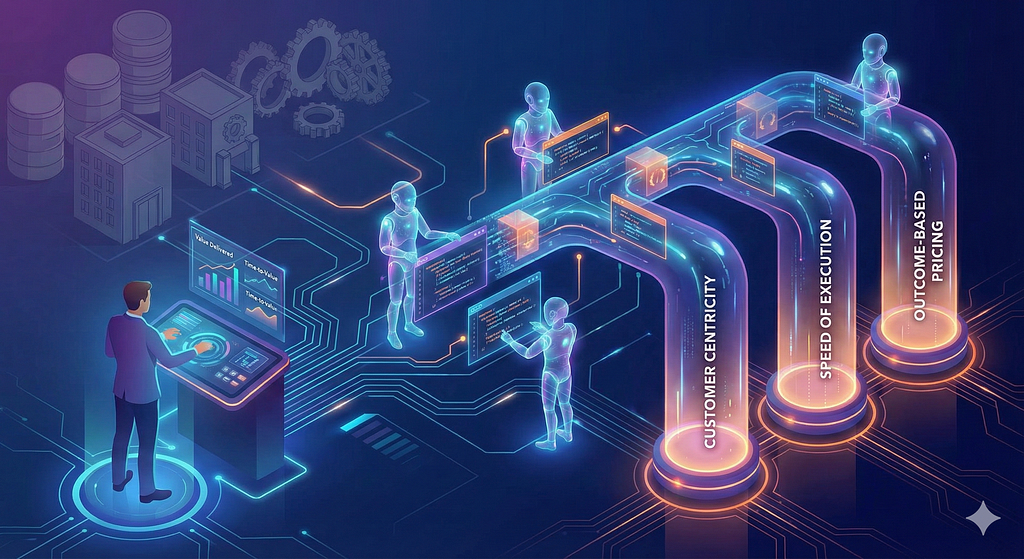
If the software itself is commoditized, how do companies compete? Success will be defined by three new pillars: Customer Centricity, Speed of Execution, and Pricing.
1. Customer Centricity: The New Minimum Bar
In a world where your product can be copied in weeks, your only true defense is the relationship you hold with your customer. Radical customer obsession is no longer a “nice to have”; it is the minimum bar to stay in business.
The era of the aloof SaaS provider taking days to answer tickets is over. Companies that operate this way will simply be replaced by a vibe-coded clone that treats the customer better. To survive, software companies must operate less like utilities and more like luxury franchises. They must build a brand where the customer feels they are the only user on the platform.
- Proactive Service: Service must shift from reactive to proactive. It is unacceptable to wait for a customer to report a bug. AI agents should monitor customer usage to identify and resolve patterns before the customer even notices. At Hypertrail, we use a “digital twin” context layer where agents enrich customer profiles before any human interaction occurs.
- The Dedicated Agent: Inspired by frameworks like OpenClaw, the future is giving every customer a “Forward Deployed Engineer” in the form of an AI. Instead of a generic helpdesk, a customer’s finance team will interact with a dedicated bot that understands their specific implementation, their data, and their organizational hierarchy.
2. Speed of Execution: Optimizing Time-to-Value
When code is instant, the bottleneck moves to decision-making and organizational friction. “Speed” now means the total time from Idea to Customer Value.
- Ideation: Traditional innovation labs are too slow. AI allows employees to “spar” with models to validate ideas and build prototypes in real-time. The challenge is the approval process. Companies must transition from weeks-long reviews to day-of approvals by assigning dedicated agent pools to valid ideas immediately.
- The “Super-Employee” (Solving the Calendar Problem): The design phase is currently slowed down by the sheer number of people involved. In a traditional setup, you have SDEs, SDMs, PMTs, and Project Managers. To make a decision, you need to find a time where five oversubscribed calendars align. This creates weeks of latency. To survive, companies must consolidate these narrow roles into “Super-Employees.” These are individuals with skills spanning product, project management, and tech, who can direct AI agents to do the deep-dive work.
- Proxy Agents: Even with super-employees, teams need to coordinate. Instead of waiting two weeks to find a meeting slot with another team to discuss an API or approval, teams should utilize Proxy Agents. My team’s agent should be able to negotiate with your team’s agent to get approvals or information. Humans should only be forced to meet for the “hairy” problems involving high ambiguity or political misalignment.
- Implementation: Code generation is solved, but guardrails are not. Agents can suffer from “context amnesia” and make catastrophic errors. Therefore, automated pipelines with rigorous testing are non-negotiable.
3. Pricing: The End of “Per Seat”
Finally, we must address the elephant in the room. The “SaaS 1.0” model of charging high premiums for access regardless of utilization is dead. Because AI makes migration between platforms trivial (agents are excellent at data transformation), lock-in is a thing of the past. Customers will no longer tolerate predatory license terms or arbitrary price hikes from the likes of Oracle or Microsoft.
Future pricing must be Outcome-Based and Usage-Based.
If the software costs pennies to build and maintain, companies can only justify revenue by proving direct value. We will see a shift toward charging for successful transactions, API calls, or resolved workflows, rather than the number of humans logging in. In this new world, you cannot increase margins by squeezing customers. You increase revenue only by delivering more efficiency.
Conclusion
The future of software is not about who can write the best code or who has the largest engineering team. Those metrics are obsolete. We are entering an era where software is a fluid, abundant resource.
For Big Tech, the challenge is dismantling the bureaucracy and calendar-gridlock that slows down their AI workforce. For SaaS, it is a forced evolution from rent-seeking to genuine value partnership. And for Startups, it is a test of architectural vision over mere coding speed.
The winners will be those who reorganize around the new bottlenecks. They will use AI to provide hyper-personalized service, they will use Proxy Agents to smash through organizational latency, and they will adopt pricing models that align their success directly with their customers’. The code is free. The value lies in what you orchestrate with it.