The Math of Ambient Intelligence: Architecting for Billions of Events
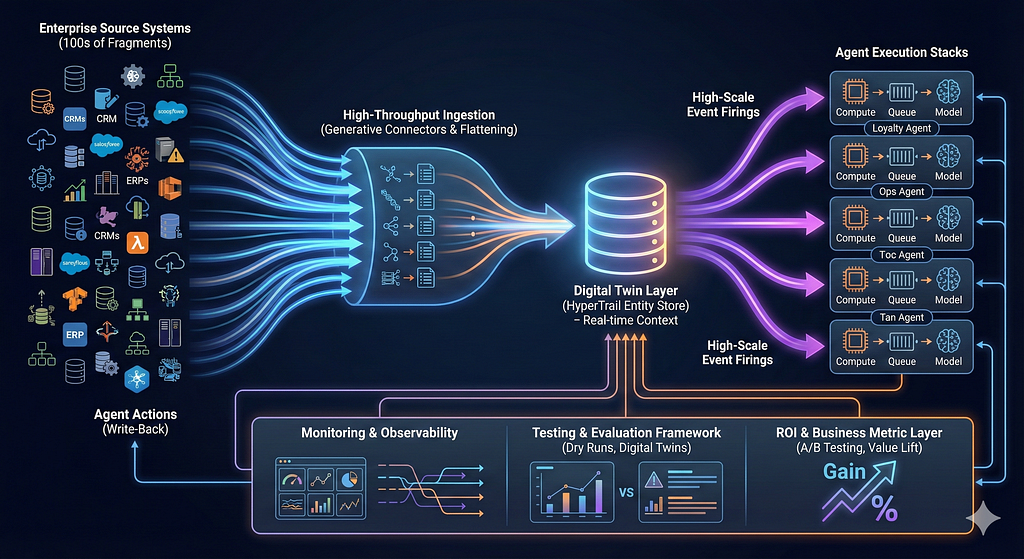
By the HyperTrail Engineering Team When we talk about “Enterprise AI,” the industry often defaults to the chatbot: a text box waiting for a human prompt. But for a Fortune 500 enterprise, the true…
By the HyperTrail Engineering Team
When we talk about “Enterprise AI,” the industry often defaults to the chatbot: a text box waiting for a human prompt. But for a Fortune 500 enterprise, the true value of AI isn’t in waiting for a user to ask a question. It is in Ambient Intelligence. It is the ability to Observe, Decide, and Act on every single business event in real-time.
But to achieve this, we have to talk about scale. Not “web scale” in the abstract, but the specific, grinding math of enterprise operations.
The Enterprise Scale: A Back-of-the-Napkin Calculation
To understand the engineering requirements of HyperTrail, let’s model a typical large American airline. Let’s assume 20 million passengers per year. To the uninitiated, that looks like 20 million database rows. To an engineer, it represents a tidal wave of event traffic.
- Reservation Systems (PSS): For every passenger, you aren’t just creating one record. You are generating booking creation messages, PNR splits, and inventory decrement messages. Then come the modifications such as flight changes, seat swaps, and meal requests. Averaging 5 modifications per trip plus the initial creation chatter, we are looking at 600 million PSS events annually.
- The Clickstream Multiplier: For every booking, there are 50 to 100 searches. Users check prices, abandon carts, and check again. Even with aggressive caching, the signal-to-noise ratio is high. This adds another 6 billion interaction events.
- The Long Tail of Ops: Add in loyalty accruals, day-of-travel gate changes, bag scans, and the 7–8 emails sent per trip.
The Result: A single enterprise generates double-digit billions of events per year. In peak operational windows, this translates to thousands of events per second (TPS).
Many “Agentic AI” platforms are built to handle a few concurrent chat sessions. HyperTrail is built to ingest this firehose, resolve it to a customer identity, and trigger an agentic workflow for every single significant event.
1. The Storage Layer: The “Entity Store” vs. The Data Lake
At 5,000+ TPS, you cannot query a Data Lake for context. We engineered the HyperTrail Entity Store specifically for this gap.
The “Flattening” Engine (Generative Connectors)
We do not dump raw, nested JSON blobs into a “swamp.” Instead, HyperTrail utilizes Generative Connectors, which are serverless functions where the ingestion code is AI-generated based on your source system examples.
- The Problem: A PSS reservation message is a 2,000-line nested nightmare.
- The Solution: The connector automatically detects the schema, generates the transformation logic, and flattens that massive blob into multiple, discrete, and optimized records before they hit the storage layer.
This structured Entity schema composed of entity-level fields and flat entity facts is not only easy for agent to work with but also ideal for use cases such as real-time identity resolution, critical to provide the context for agents.
The Customer Identity Problem
In retail, a user is usually just a User ID. In travel, identity is fractured. A customer might be a logged-in User ID on the app, but a “Guest” with just a surname and credit card hash on an OTA booking, and a PNR Record Locator in the mainframe.
- The HyperTrail Fix: Our storage layer performs probabilistic and deterministic matching in real-time. It reconciles these “ghost profiles” by merging a booking from Expedia with a clickstream from the app to create a coherent “Digital Twin.” Crucially, it also handles the un-merging or splitting of profiles when data proves distinct, which is a complexity most generic CDPs fail to handle at scale.
2. The Compute Architecture: Single-Multi Tenancy
Handling a steady stream of traffic is one thing. Handling a “Nike Air Jordan Drop” is another. In an enterprise environment, traffic is spiky. If all customers shared a monolithic queue, a noisy neighbor could degrade the entire platform.
Our Approach: Use-Case Isolation via Serverless Stacks. We do not use a shared resource pool for agent execution. Instead, HyperTrail deploys dedicated serverless infrastructure (compute, queues, and streams) for each specific agentic use case.
- Isolation: The “Flight Cancellation Agent” stack is physically separate from the “Up-sell Agent” stack.
- Scalability: If a global promotion triggers 10,000 concurrent up-sell checks, that specific stack scales elastically without impacting operational reliability for other workflows.
3. Observability: The “Black Box” Problem
When you are running thousands of autonomous decisions per second, “logging” isn’t enough. If a customer complains about an AI decision, a support agent needs to know exactly why the AI took that action.
We built a Trace-Based Monitoring Layer directly into the Hypertrail Administration Portal which provides the following benefits:
- End-to-End Traceability: You can trace a specific decision back to the initial raw event injection, through the “flattening” process, into the specific LLM prompt version used, and finally to the downstream API call.
- Auditability: This isn’t just for debugging; it’s for compliance. Every AI thought process is recorded, allowing you to answer why the agent offered a refund to Customer A but not Customer B.
4. The Economics of Inference: Future-Proofing for ROI
Running agents at 5,000 TPS using GPT-4 would bankrupt most departments. The cost could easily reach tens of millions annually.
Model Agnosticism & The SLM Shift We enable enterprises to route high-volume, low-complexity tasks to highly optimized Small Language Models (SLMs). Most tasks like parsing a JSON or checking a balance do not require frontier-level intelligence.
The “No-Markup” Pricing Model Crucially, we do not charge a markup on tokens.
- The Philosophy: AI costs are dropping rapidly. New, cheaper models are released monthly.
- The Benefit: If a new model comes out that is 10x cheaper, you can switch to it instantly using our Evaluation Framework to verify performance. Because we don’t arbitrage token costs, 100% of those savings go to you. We monetize our value based on Compute and Storage, not your consumption of intelligence.
5. Evaluation & ROI: The “Digital Twin” Advantage
Most AI projects fail because ROI is calculated on “vibes.” HyperTrail solves this with Built-in Experimentation.
Because our Entity Store mirrors your valuable business data like bookings, revenue, and churn, we can run A/B tests natively.
- Control Group: Users not touched by the agent.
- Test Group: Users handled by the agent.
- The Metric: We don’t just measure “sentiment” but instead measure Revenue Lift and Retention.
We calculate this lift directly within the platform, providing directionally correct and statistically significant proof of value without requiring a separate data science project.
The Central Nervous System
To operate an autonomous enterprise, you don’t need a chatbot. You need a central nervous system capable of listening to the double-digit billion events your systems generate, understanding the context, and acting instantly.
HyperTrail provides the storage, the isolated compute, the observability, and the economic model to turn that noise into signal and that signal into action.
Ready to Architect for Scale?
Stop building chatbots. Start building ambient intelligence.
Visit hypertrail.ai to explore the platform and request a deep-dive technical demo.